
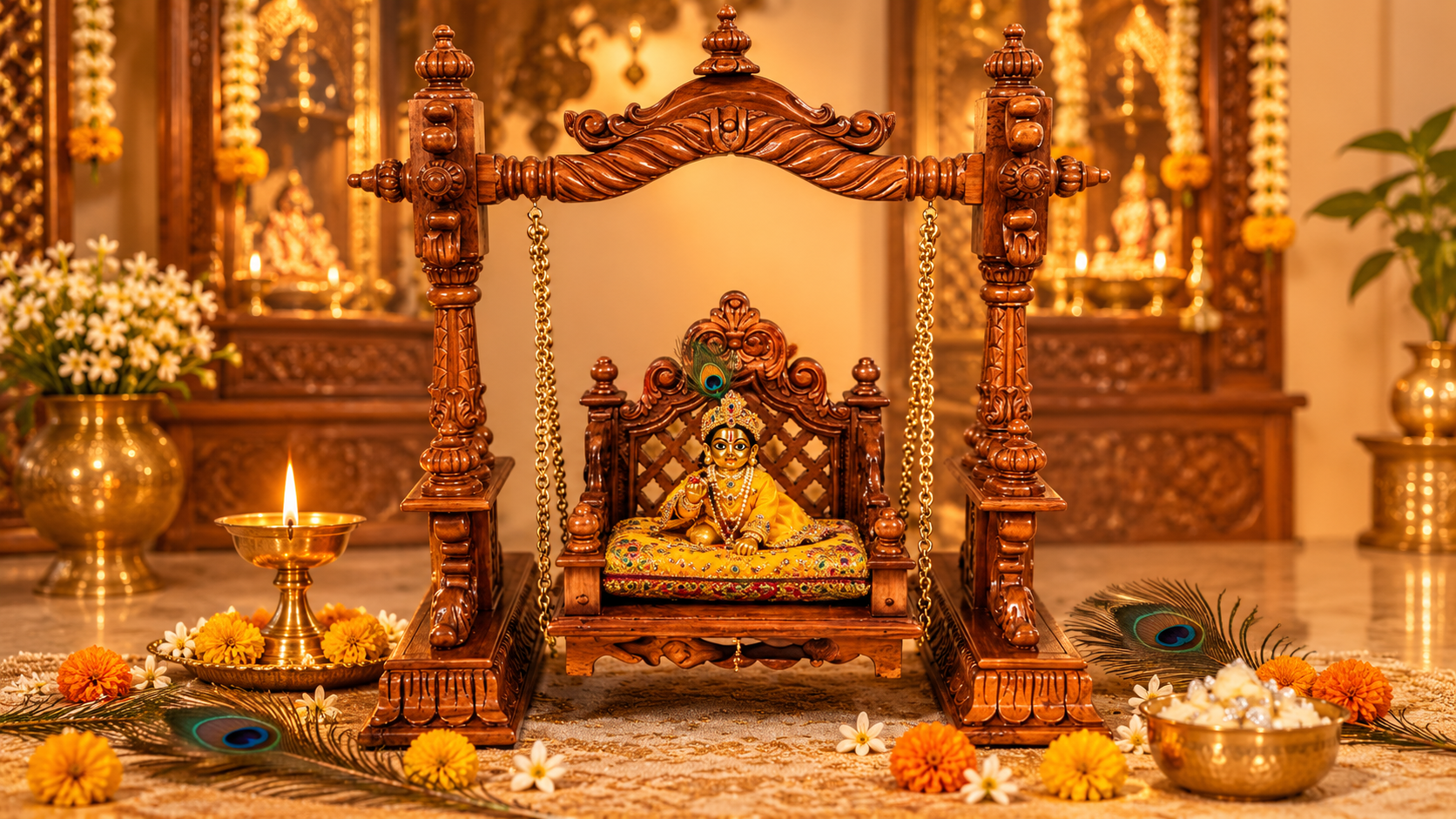
In many Indian homes, Laddu Gopal is not simply an idol on a shelf. He is woken gently in the morning, bathed, dressed in tiny clothes, offered bhog and, in the evening, rocked to rest in his own little swing. That swing, the Krishna jhula, is one of the most loved pieces in a home mandir, and choosing the right one is a small act of devotion in itself.
At SOM, our carvers in Tamluk, West Bengal have been hand-carving devotional furniture for more than 22 years. In this guide, we share why the jhula holds such a special place in Krishna seva, and how to choose a hand-carved teak wood jhula that suits your Laddu Gopal, your mandir and your family's daily rituals.
Why Krishna Is Rocked in a Jhula
The image of baby Krishna being lovingly swung by Mother Yashoda is one of the most tender stories in Indian devotion. Rocking Laddu Gopal in a jhula is a way of reliving that bond, offering care and affection rather than formal worship alone. Many families swing the jhula during the evening aarti or before the deity's rest, and the swing takes centre stage during festivals like Janmashtami and Jhulan Yatra, when homes and temples decorate Krishna's swing with flowers and lights.
1. Choose the Right Size for Your Laddu Gopal
The most common mistake is buying a jhula without measuring the idol. Before you choose:
Measure the idol's height and base: Laddu Gopal idols range from very small to quite large, so the seat should hold him comfortably with a little space around.
Allow room for clothes and cushions: poshak, a small pillow and a mattress or asan add height and width.
Check the height of the frame: the canopy or top bar should sit well above the crown and mor pankh, so nothing touches while swinging.
Plan for the future: if your family may welcome a larger idol later, a slightly bigger jhula is a sensible choice.
2. Make Sure It Fits Your Mandir
A jhula usually sits inside or in front of the home mandir, so measure the space it will occupy, including the room needed for the seat to swing freely without touching the mandir walls or other idols. If you are planning a new mandir, it helps to choose both together so their size, carving and finish feel like a matched set. Our Temple Collection includes mandirs with generous inner space suited to a jhula.
3. Why Solid Teak Wood Is the Best Choice
A Krishna jhula is handled every single day, moved during cleaning and swung again and again. It also lives close to diyas, incense and the occasional splash during abhishek. Solid teak wood is ideal because:
It is strong and stable: joints and hanging points stay firm through years of gentle swinging.
It resists moisture and termites naturally: the oils in seasoned teak help it handle humidity and the odd spill far better than softer woods or engineered boards.
It holds fine carving: lotus petals, peacocks and small domes stay crisp even at miniature scale.
Curious how teak compares with other materials? Read our guide on teak vs sheesham vs engineered wood.
4. Carvings That Carry Krishna's Story
A hand-carved jhula is a chance to bring Krishna's world into your mandir. Popular motifs include:
Peacocks and peacock feathers: a symbol closely linked with Krishna, his mor pankh and the forests of Vrindavan.
Lotus flowers: purity and divine beauty, often carved on the seat or base.
Cows and calves: a gentle reminder of Gopal, the protector of cows.
Temple-style domes and arches: giving the jhula the feel of a tiny shrine of its own.
To understand the deeper meaning behind these motifs, see our post on sacred symbols in mandir design.
5. Pick a Finish That Suits Your Home
Natural teak polish: warm and timeless, perfect alongside a natural teak mandir.
Gold accents: highlights the carving and adds a festive glow under diya light.
White and gold: bright and elegant, ideal for modern apartments and white mandirs.
6. Look Closely at Safety and Swing Quality
A good jhula should swing smoothly and quietly, without wobbling. Check that:
The base is wide and heavy enough to stay steady while the seat moves.
The hanging chains, rods or hooks are firmly fixed and finished without sharp edges.
The seat has a raised rail or back so the idol and cushion stay securely in place.
Joints are tight, with no gaps or loose pieces.
Caring for Your Krishna Jhula
Dust daily with a soft, dry cloth, especially the carved areas.
Keep diyas on a brass or clay stand, never directly on the wooden base.
Wipe up water or milk immediately after abhishek and let the wood dry fully.
Use flowers and decorations that do not leave stains, and remove wet flowers the same day.
For a complete routine, our season-by-season teak care guide covers everything you need.
A Swing Made With Devotion
Every SOM Krishna jhula is hand-carved in teak wood by master craftsmen and finished in patient, hand-rubbed layers, so it can be part of your family's seva for generations. Explore our Krishna Jhula Collection, including our handcrafted Laddu Gopal swing and wooden Krishna jhula.
Need a jhula sized exactly for your idol or designed to match your mandir? Contact us or begin your bespoke journey, and our artisans will carve one just for your Gopal.