
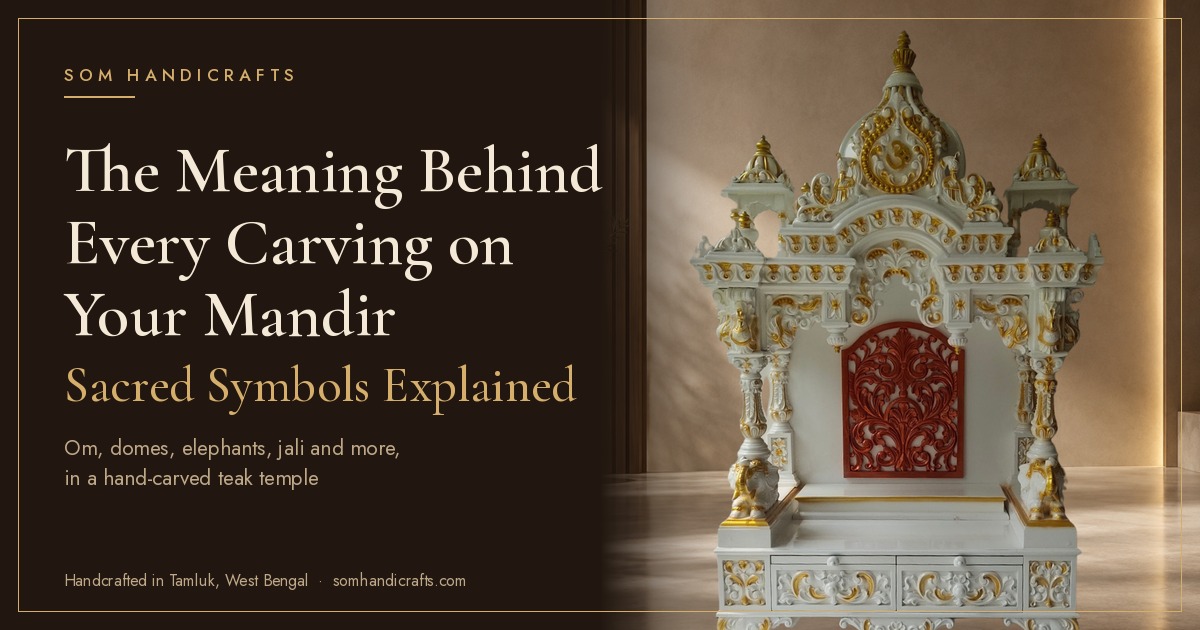
Stand in front of a hand-carved mandir for a few moments and you begin to notice things: a sacred syllable at the crown, small domes rising at each corner, elephants guarding the pillars, a delicate lattice framing the deity. None of this is decoration for its own sake. Each motif carries centuries of meaning, borrowed from the great stone temples of India and carved, in miniature, into the shrine that sits in your home.
At SOM, our master carvers in Tamluk, West Bengal have been shaping these motifs by hand for more than 22 years. Here is a guide to the most common symbols you will find on a traditional wooden mandir, what they represent, and how to choose the ones that feel right for your family.
1. The Shikhara and Domes: Rising Towards the Divine
The tall, tapering crown at the top of a mandir is inspired by the shikhara, the towering spire of a Hindu temple. In temple architecture, the shikhara represents the sacred mountain, a symbolic path from the earthly to the divine.
The central dome marks the spiritual heart of the shrine, directly above the space where the deity sits.
Smaller corner domes, like the four turrets on the mandir shown above, echo the subsidiary spires of large temples and give the piece a sense of balance and grandeur.
Layered tiers beneath the crown add height and draw the eye upward, the same way a temple's tower guides the gaze of a devotee.
2. The Kalash Finial: Abundance and Auspicious Beginnings
Look at the very tip of each dome and you will usually find a small pot-shaped finial. This is the kalash, a sacred vessel associated with abundance, life and new beginnings. On temples it crowns the highest point of the structure, and on a home mandir it serves the same role: a blessing placed at the summit of the shrine. On white and gold mandirs, these finials are often highlighted in gold so they catch the light of the evening diya.
3. Om: The Sacred Sound at the Heart of the Shrine
Many mandirs carry an Om carved at the crown, as in the piece above, where it sits within a gilded teardrop frame at the centre of the main dome. Om is regarded as the primordial sound, the vibration from which creation emerges, and it is chanted at the beginning and end of prayers.
Placing Om at the highest, most central point of the mandir makes it the first thing seen when you stand before it, a quiet reminder of the purpose of the space. Some families prefer other sacred symbols here instead, such as a Swastik, a Ganesha motif or a family deity's emblem, and this is one of the easiest details to personalise.
4. Elephants: Strength, Wisdom and Good Fortune
Carved elephants at the base of the pillars are among the most loved motifs in Indian temple craft. The elephant is associated with strength, wisdom, prosperity and royalty, and is closely linked with Lord Ganesha, the remover of obstacles who is invoked at the start of every auspicious undertaking.
Placed at the foot of the pillars, elephants appear to support and guard the sanctum.
Facing outward, they symbolically welcome those who come to pray.
Highlighted in gold on a white mandir, they become a striking focal point at eye level when you are seated for puja.
5. Pillars: The Threshold of the Sacred Space
The turned and fluted pillars on either side of the sanctum recall the carved columns of a temple's mandapa, the hall devotees pass through before reaching the inner shrine. On a mandir, the pillars mark the threshold between everyday space and sacred space. The more layered the carving, with bands of beads, petals and rings, the more the pillars seem to rise like stacked offerings.
6. The Jali Back Panel: Light, Breath and Focus
Behind the deity, many mandirs feature a pierced lattice panel called a jali. In traditional architecture, jali screens allowed light and air to pass while softening the view beyond. In a home mandir, the jali creates a rich, textured backdrop that frames the idol and draws attention to the centre.
A contrasting jali, such as the deep red panel set against white and gold above, makes the deity stand out beautifully, especially when lit by a diya or warm light. Common jali patterns include flowing vines, the tree of life and paired peacocks, each adding its own layer of meaning.
7. Lotus, Vines and Floral Scrolls: Purity and Growth
Floral carving runs through almost every surface of a traditional mandir, from the arches to the drawer fronts.
The lotus rises clean and unstained from muddy water, and so represents purity, spiritual awakening and detachment. It is closely associated with Lakshmi, Saraswati and Vishnu.
Climbing vines and scrolls suggest continuity, growth and the flourishing of the household.
Bud and petal borders along the cornices frame the structure much like garlands of fresh flowers.
8. Steps, Platform and Carved Feet: Raising the Divine
Most mandirs place the deity on a raised platform, sometimes with one or more steps leading up to it. Elevating the idol is a gesture of reverence, and traditional guidance generally prefers that deities are not kept directly at floor level. Finally, many mandirs stand on carved feet, such as the lion-paw style seen above, symbols of strength and stability that lift the whole shrine and complete its regal stance.
Why White and Gold Makes the Carving Speak
On a natural teak mandir, the carving reads through the grain and the play of light and shadow. On a white and gold mandir, it reads through colour. The white base gives the shrine a serene, peaceful presence, while gold highlights pick out each sacred motif, from the Om at the crown to the elephants at the pillars, so the symbolism is visible from across the room. It is a particularly good choice for modern homes with light walls and marble flooring, where the mandir should feel bright and calm rather than heavy.
Behind the colour, it is still solid teak. Our white and gold teak wood mandirs are carved first, then finished in a white duco polish with hand-applied gold accents, so the carving underneath has real depth and the finish follows every curve.
Choosing Symbols That Reflect Your Family
Every family's faith and traditions are different, and a mandir should reflect yours. When planning a piece, consider:
The symbol at the crown: Om, Swastik, a deity's emblem, or a motif linked to your family tradition.
The guardian figures: elephants, lions, peacocks or none at all for a cleaner look.
The jali design and colour behind the deity.
The finish: natural teak, white and gold, dark walnut and gold, or all-gold.
For guidance on size, storage and placement, read our guide on how to choose the perfect teak wood mandir for your home. To keep gold detailing and light finishes looking their best, see our season-by-season teak care guide.
A Shrine Carved With Meaning
When every motif on your mandir has been carved by hand and chosen with intention, the shrine becomes more than furniture. It becomes a small temple that tells your family's story of faith, one carving at a time.
Explore our Temple Collection, discover the craftsmanship behind each piece, or design a mandir with your own chosen symbols through our bespoke service. Speak with our design consultants on the Contact page or on WhatsApp. Every SOM mandir is made to order and delivered across India and worldwide.
A legacy begins with a single piece. Let yours carry meaning in every carving.