
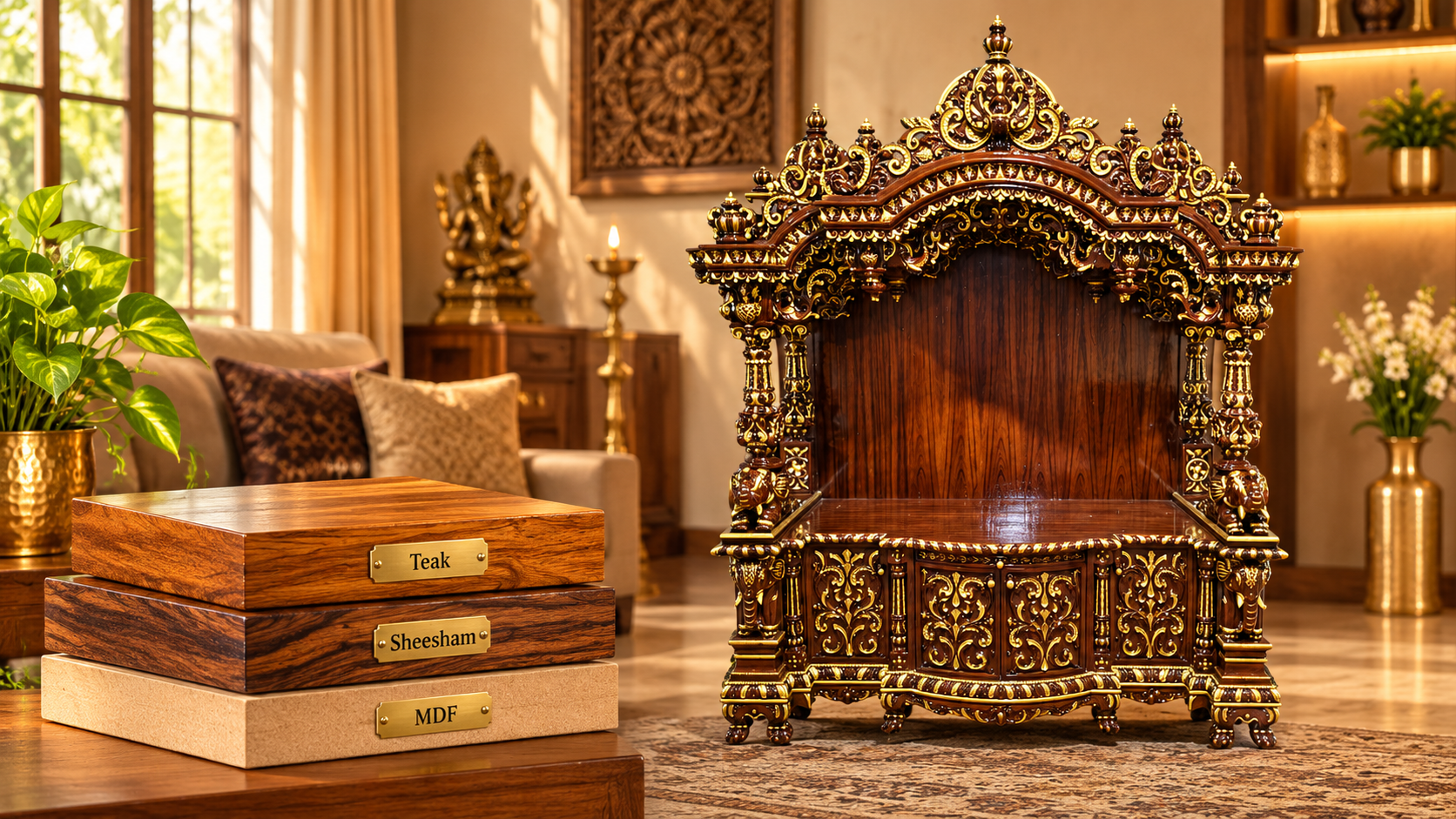
Walk into any furniture market in India and you will hear the same three words again and again: teak, sheesham and "engineered wood". Each is sold as strong, beautiful and long-lasting, and the price tags can differ by several times for pieces that look similar in a showroom photo. So which one actually deserves a place in your home, especially when you are buying a carved piece meant to last for decades?
At SOM, our craftsmen in Tamluk, West Bengal have been working with wood for more than 22 years. Here is an honest, practical comparison of the most common furniture materials in India, how each behaves over time, and which one suits which kind of piece.
1. Teak Wood (Sagwan): The Heirloom Standard
Teak has been the first choice for temples, palaces and ship decks for centuries, and for good reason. It is a dense, close-grained hardwood rich in natural oils, which give it a few qualities no other common furniture wood fully matches:
Natural resistance to moisture and termites: the oils in well-seasoned teak help it stay stable through Indian monsoons and resist insect attack far better than most woods.
Dimensional stability: properly seasoned teak shrinks and swells very little, so joints stay tight and carved panels do not crack easily.
Superb carving response: its even grain lets a master carver cut fine details, deep relief and crisp edges that hold their shape for generations.
Ages gracefully: with simple care, teak develops a richer, warmer golden-brown tone over the years instead of looking tired.
The trade-off is cost. Teak is the most expensive of the common options because quality timber is limited and must be seasoned carefully. But for a wooden mandir, a carved sofa or a bed you expect your children to inherit, it is the material that justifies the investment.
2. Sheesham Wood (Indian Rosewood): Strong and Striking
Sheesham is a popular Indian hardwood known for its bold, dark streaks and attractive grain. It is hard and dense, which makes it a good choice for everyday furniture like dining tables, chairs and side tables.
Strengths: good hardness and strength, a beautiful natural pattern, and usually lower cost than teak.
Watch-outs: sheesham needs thorough seasoning. If it is not dried properly, it can develop cracks or warp, especially in very dry or very humid rooms. It has less natural oil than teak, so its resistance to moisture and insects depends more on the finish.
Carving: it can be carved well, but its interlocked grain makes very fine, delicate motifs harder to execute cleanly compared to teak.
Sheesham is a sensible choice for solid, simpler designs. For highly detailed temple-style carving that must stay crisp for decades, teak usually performs better.
3. Mango and Other Softer Hardwoods: Budget-Friendly but Limited
Mango wood and similar softer hardwoods are widely used in mass-produced furniture because they are affordable and easy to work. They can look lovely when new, but they are softer, more prone to dents and scratches, and more vulnerable to insects and moisture if not treated well. They are fine for light-use decor pieces, but rarely the right base for an heirloom.
4. Engineered Wood (MDF, Particle Board and Plywood): Modern Convenience
Engineered wood is made from wood fibres, chips or veneers bonded with resin. It powers most modular kitchens and flat-pack wardrobes because it is affordable, uniform and quick to produce.
Good for: flat, modular, budget-conscious furniture with laminate finishes.
Not suited to: deep hand carving. There is no solid timber to carve into, so "carved" engineered pieces usually rely on pasted mouldings or CNC-cut thin panels.
Moisture is the enemy: MDF and particle board can swell permanently if water seeps through an edge or joint, which is a real concern in Indian homes during monsoon.
Lifespan: it typically lasts years, not generations, and is very hard to repair or refinish.
Quick Comparison at a Glance
Durability: Teak (excellent) > Sheesham (very good) > Mango (moderate) > Engineered wood (limited)
Moisture and termite resistance: Teak leads naturally; the others depend heavily on treatment and finish.
Hand carving detail: Teak is the best canvas; sheesham is good; engineered wood cannot be truly hand-carved.
Refinishing in the future: Solid teak and sheesham can be sanded and re-polished many times; engineered wood usually cannot.
Upfront cost: Engineered wood is cheapest, teak is the most expensive.
Which Wood for Which Piece?
The right material depends on how a piece will be used and how long you want it to stay with your family:
Mandir and pooja furniture: teak, without question. A mandir is carved in fine detail, lit with diyas, exposed to incense and handled daily, and it is usually meant to stay for generations.
Carved sofas, beds and swings: teak, because these pieces carry weight and movement every day, and their carving and joinery must stay strong. Explore our Signature Sofa Collection and Royal Swing Collection.
Simple dining or study furniture: well-seasoned sheesham is a reasonable choice.
Kitchen cabinets and modular storage: good-quality plywood with a proper laminate is practical here.
Think in Cost Per Year, Not Just Price
A low-cost wardrobe that has to be replaced every eight to ten years often ends up costing more over a lifetime than one well-made solid teak piece that lasts fifty years or more and can be re-polished whenever it starts to look tired. When you add the emotional value of a piece that holds family memories, the case for buying once and buying right becomes even stronger.
How to Make Sure You Are Getting What You Pay For
Because teak commands a premium, it is also the wood most often misrepresented. Ask the seller to confirm the wood species in writing, check the weight and grain, and ask how and for how long the timber was seasoned. Our guide on how to identify original teak wood furniture walks you through nine simple checks before you buy.
Choose Wood That Will Outlive the Trend
Every SOM piece is hand-carved from carefully selected, seasoned teak wood and built with traditional joinery, so it is ready to become part of your family's story. If you are unsure which material or design suits your space, our team is happy to guide you. Visit our craftsmanship page to see how each piece is made, or get in touch to discuss a bespoke piece made to your exact needs.